
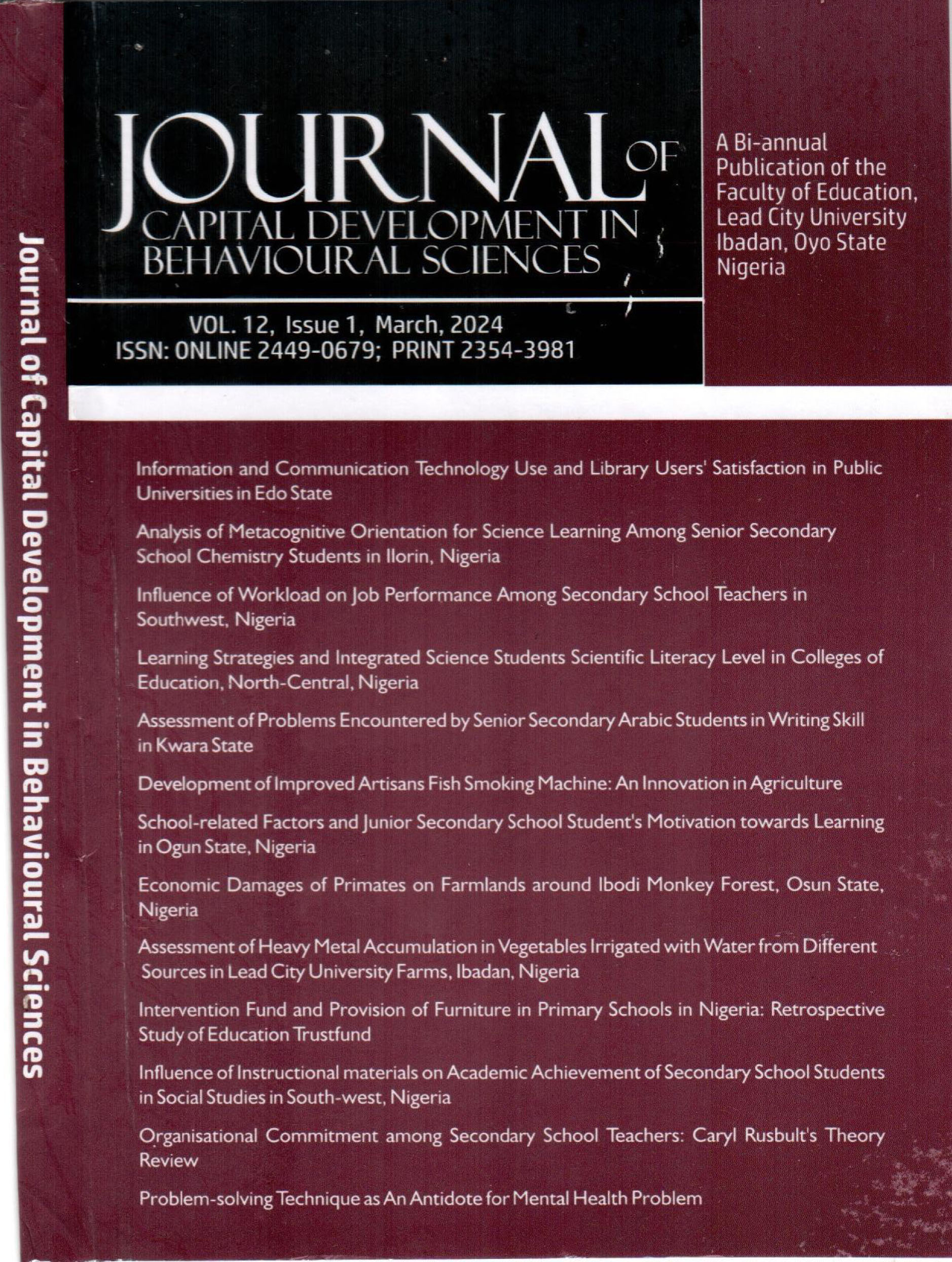
Journal Of Capital Development in Behavioural Sciences · ISSN 0000-0000

Volume 12 · Issue 1 — 2024

This volume collects 13 peer-reviewed articles, published February 2025.

Volume 12 cover
Table of contents

Issue 1 · February 2025

13 articles
Article 1 of 13

Analysis of Metacognitive Orientation for Science Learning Among Senior Secondary School Chemistry Students in Ilorin, Nigeria

View PDF

Students metacognitive orientations has been reported to be a potent tool in helping students to develop higher-order thinking skills as well as becoming potential problem solvers. This study analyzed the metacognitive orientations for learning science among secondary school students in Ilorin metropolis. The study adopted descriptive research of the survey type. A sample of 520respondents who were selected through a simple random sampling technique was involved in the study. The instrument used for data gathering was adopted from Thomas, Anderson, and Nashon (2008) entitled Self-efficacy and Metacognitive Learning Inventory- Science (SEMLI-S). Data were analyzed using mean, standard deviation, t-test and ANOVA. Findings from the study revealed that students have high metacognitive orientations for learning Science. Also, class level and students’ gender did not significantly influence their metacognitive orientations towards learning science. Furthermore, school type did not significantly influence their metacognitive orientations. The study

Article 2 of 13

Information and Communication Technology Use and Library Users’ Satisfaction in Public Universities in Edo State

View PDF

This study investigated the influence of ICT use by librarians on library user satisfaction in public universities in Edo State. The research identified the level of library users’ satisfaction, examined the level of ICT use by librarians, and determined the influence of ICT use on library users’ satisfaction. The research provided insight into the use of ICT by librarians in relation to libraryusers’ satisfaction within Edo State. The models adopted were Expectancy disconfirmation and Technology Acceptance Models. The descriptive survey research design was adopted. The population of the study is 12,400 library users. A sample of 388 library users was used, and the sampling technique adopted was the simple random sampling technique. The structured questionnaire was the instrument for data collection, and data was analysed using descriptive and inferential statistics. Findings showed that library userswere satisfied with service delivery of librarians, library users perceived that librarians highly use ICTs. Findings also revealed that ICT use influenced users’ satisfaction (R2  = 0.448; F = 250.565; p = 0.001). The research concluded that library users rarely patronise the library, despite the high ICT usag skills. The research recommended that librarians should embrace the use of ICTs in order to render effective and efficient services

Article 3 of 13

Influence of Workload on Job Performance Among Secondary School Teachers in Southwest, Nigeria

View PDF

Recently, concerns have been raised regarding the quality of job performanceamong teachers in secondary schools in Southwest Nigeria with respect totheir workload. This study investigated the influence of workload on the jobperformance of secondary school teachers in Southwest Nigeria. Descriptivesurvey research design was employed. The population consisted of teachersand principals from 2,262 public and 2,318 private secondary schools inSouthwest Nigeria. A multistage sampling technique was used. Threeinstruments-Workload Questionnaire (WQ)(á = 0.78), Teachers’Administrative Job Performance Questionnaire (TAJPQ)(á = 0.67) andTeachers’ Instructional Job Performance Questionnaire (TIJPQ)(á = 0.7) wereused for data collection. Two research questions and three hypotheses wereraised and answered. The results revealed that public secondary schoolteachers had a high level of job performance in both administrative (mean=0.347) and instructional (mean=0.314) responsibilities, while privatesecondary school teachers had a high level of job performance in bothcategories as well(mean=2.98, mean=3.58). Test of hypotheses revealedthat there is a significant joint influence of workload indices (working timeand class size) (Adjusted R2=0.808, F=1601.069; p<0.05) on teachers’job performance in secondary schools in Southwest, Nigeria. It was also foundthat working time has the highest relative influence on job performance (â =1.063; t = 36.933, p < 0.05) followed by class size (â = 0.059; t =1.385, p > 0.05). There was significant difference of job performance ofteachers based on school types (Public – mean =0.4000, Private – mean =0.830). It was recommended that there is a need for ongoing professionaldevelopment opportunities for teachers, clear expectations and guidelinesset by the government and school administrators.

Article 4 of 13

Learning Strategies and Integrated Science Students Scientific Literacy Level in Colleges of Education, NorthCentral, Nigeria

View PDF

The paper examined the impact of Integrated Learning Strategies on the scientific literacy of college science students. The study adopted a quasi experimental design using intact classes. Two research questions and hypotheses were each asked and tested. The population for the study comprised all colleges of education in north-central Nigeria; two colleges were randomly sampled by the use of table of random numbers. A total of 80 students formed the experimental group and 100 students formed the controlgroup. A science literacy test validated with a reliability index of .74 was administered before and after the intervention and scored for data pool. The data collected were analysed using descriptive and inferential statistics at p<0.05 level of significance. Results showed that the scores obtained by the experimental group exposed to the Integrated Teaching Strategy were higher than the scores of the control group on the basis of scientific literacy and that there was a significant difference in the scores of the experimental and controlgroups. It was also found out that there was no significant difference in the scores of male and female colleges of education science students with reference to scientific literacy. It was recommended that the use of Integrated Learning Strategies should be encouraged since it can improve scientific literacy and it  is gender friendly.

Article 5 of 13

Assessment of Problems Encountered by Senior Secondary Arabic Students in Writing Skill in Kwara State

View PDF

Writing is an essential skill in the process of learning, in writing one single misspelt letter can change the word’s meaning and create problems with communication process. This study assessed the problems encountered by senior secondary school Arabic students in writing skill in Kwara State. Descriptive survey research design was employed for the study. The population of the study comprised of all secondary school Arabic Students in the state while target population was all senior secondary 3 (SS III) students thatregistered for Arabic Language in the SSC Examinations (SSCE). Cluster sampling technique was used to select 210 students that registered for Arabic Language in the State,WASSCE 2022 Arabic essay question was adapted and used for data collection. WASSCE questions are assumed to be products of standardised examinations. Mean was used to answer research Questionsand hypotheses were tested with the use of t-teststatisticat 0.05 alpha level.The findings revealed that students’ general performance in Arabicessay was above average,there was no statistically significant difference between problems encountered by male and female, and there was a significant difference in the problems encountered by public and private Arabic students in essay writing. The study recommended that attention should be given by the teachers to spelling errors encountered by students in Arabic essay writing.

Article 6 of 13

Development of Improved Artisans Fish Smoking Machine: An Innovation in Agriculture

View PDF

The objective of the study was to develop an improved artisan’s fish smoking machine (IAFSM) with micro environment type of smoking chamber for fish smoking and incorporated a sawdust stove with inlet vents to produce hot and non-dense smoke under natural influence at high temperature and velocity. A wooden frame was developed according to the required dimensions; internalwalls were nailed to the frame from inside; the internal walls were made of stainless metal sheets that were cut into required sizes. Thin layer of dried and powdery red clay soil was formed within the thickness of the wall frame after some quantity of the material was poured, and a thick layer of cotton wool was placed on it thereafter, plywood was fixed to the frame from outside to cover these lagging materials. These sets of activities were repeated for the remaining three sides including the door, top and the lowest flat parts of the machine. The dried sawdust was compressed in the IAFSM’s stove with the volume 1.25 × 108 mm3, flux guide, and a fire screen. An outlet vent is located at the top of the machine. When the compressed dried sawdust was ignited with dried pieces of paper when the door was closed; the fuel burns under natural influence without the use of fan in any form. The exhausted flux escaped via the outlet vent and away from the artisans, as soon as, its cooks the fish. A hot and non - densed smoke generator has been developedto smoke fish at a cheaper and faster rate with heat energy and non - densed smoke delivered to the fish at the rate between 86.9 J/S and 92 J/S from the heat energy delivered to the smoking chamber at a rate between 108.6 J/S and 127.8 J/S. Satisfactory taste reports were received after the interview granted by the 20 members of the public randomly selected and served with the samples of the smoked fish. The developed mechanical aid: Is environmentally friendly; Uses coal or similar fuel material that can smoulders;and Smokes fish faster than any devices in the existing literature, less than an hour, with significant moisture loss.

Article 7 of 13

School-related Factors and Junior Secondary School Student’s Motivation towards Learning in Ogun State, Nigeria

View PDF

The intricate relationship between school-related factors and student motivation had become a pivotal focus in contemporary educational discourse, particularly in the context of junior secondary education. This study delves into the multifaceted dynamics of this relationship to shed light on the nuanced implications of school-related factors on the motivation of junior secondary school students. By investigating the combined and relative influence of teacher support, classroom rules, and instructional resource availability, the research offered valuable insights into optimising learning environments and fostering a sustainable culture of academic enthusiasm. The study employed a descriptive survey research design gathering data from a representative subset of470,449 students from 510 public junior secondary schools in Ogun State, Nigeria. Using multiple regression analysis, the findings underscored the significant combined influence of school-related factors on student motivation (F = 79546.842, p < 0.05), with instructional resource availability demonstrating the highest relative influence ( = 0.570, p < 0.05), followed by teacher support ( = 0.223, p < 0.05), and classroom rules ( = 0.041, p < 0.05). The study highlights the need for continuous investment in instructional resources, comprehensive professional development for educators, and the adoption of a balanced approach to classroom management to foster a conducive learning environment and enhance student motivation. Recommendations included prioritizing resource provision, comprehensive teacher development programs, balanced classroom management approaches,and increased parental engagement to bolster student motivation and learning outcomes.

Article 8 of 13

Economic Damages of Primates on Farmlands around Ibodi Monkey Forest, Osun State, Nigeria

View PDF

There have been the reports of incidence of primate’s invasion within the vicinity of Ibodi Monkey Forest, in Osun State, Nigeria. This article examined the expected losses incurred, owing to damages caused by primates on farmlands as well as the techniques of control. For the study, primary data were gathered and used. Open-ended questionnaires were used to gather data, and they were given to all the affected farmers in the research area. In order to identify and sample the impacted farms, the non-probability snowballing method was applied. The outcome showed that each farmer in the settlements of Eriperi, Iyemogun, Isaobi, and Ileki-Ijesha lost an estimated average amount of cocoa valued at N67,656.35±420.90, â‚N68,248.14±500.97,â‚N66,094.73±482.22, â‚N67,817.90±554.17, respectively. Also, an estimated average of â‚N3,979.18, N3,981.33, N3,974, and N3,905.85 worth of maize were lost on farmlands by each farmer at Eriperi, Iyemogun, Isaobi and Ileki-Ijesha settlements respectively.  dditionally, in the aforementioned communities, an estimated average of N4,780.53, N3,993.50, N5,834.48, and N5,321.99 worth of cassavaplants were lost to primates. Additionally, the majority of respondents (37.8%, 18.2%, 20.1% and 23.9% in Eriperi, Iyemogun, Isaobi, and Ileki-Ijesha, respectively) used firearms to manage primates on their farmlands. The data also demonstrates that traps, scarecrows, chasing and firearms were the four (4) fundamental primate-invasion control methods utilized by farmers in the study locations to reduce damage. On the basis of the study’s findings, recommendations were made.
 

Article 9 of 13

Assessment of Heavy Metal Accumulation in Vegetables Irrigated with Water from Different Sources in Lead City University Farms, Ibadan, Nigeria

View PDF

Rapid and unorganised industrialisation and urbanisation has contributed to the elevated levels of metals in the urban environment in developing countries, with attendant effect on the health and wellbeing of final consumers of such agro-products. This study was conducted to assess the amount of heavy metal accumulated by selected tropical leafyvegetablesirrigatedwith waste-waterfrom different sources; poultry waste water, Kitchen waste water and borehole water as control. The sampled vegetables used were Amaranthus hybridus, Telfaria occidentalis and Corchorus olitorus. The vegetables were grown for a period of six weeksin the screen-house of the LCU farms, Lead City University, Ibadan Oyo State, Nigeria. The vegetables were irrigated with the differentwater sources, after which the vegetable leaves were harvested and taken to the Microbiology laboratory. Elemental analysis of the vegetables was determined using the Atomic Absorption Spectro-photometer(AAS) and pH level ofthe soil and irrigationwater was assessed. The results indicated the elemental composition of the Bore-Hole Water (BHW) as (Cu=0mg/kg), (Pb=0mg/kg), (Fe=0.018 mg/kg), (Zn=0.038mg/kg) and (Mn=0.0026mg/kg); Kitchen- W a s te water (KWW) was (Cu=0178mg/kg), (Pb=0.035mg/kg), (Fe=0.023mg/kg), (Zn=0.025mg/kg) and(Mn=0.0031mg/kg) Poultry- Sewage water (PSW) is (Cu=0.029mg/kg), (Pb=0.048mg/kg), (Fe=0.0547mg/kg), (Zn=0.147mg/kg) and (Mn=0.0033mg/kg). PSW had the highest composition of heavy metals; comparing the vegetables, C. olitorius accumulated more Iron(Fe), Lead(Pb) and Copper(Cu), while T. occidentalis accumulated more Zinc (Zn) and Manganese (Mn) than A. hybridus. PSW contained substantial amount of heavy metals varying according to source while Corchorus olitorus and Telfaria occidentalis showed a high affinity for accumulation of heavy metals

Article 10 of 13

Intervention Fund and Provision of Furniture in Primary Schools in Nigeria: Retrospective Study of Education Trustfund

View PDF

This study investigated the utilisation of financial resources of the Education Trust Fund (ETF) on the provision of furniture in public primary schools in the South-West geo-political zone of Nigeria. Tax payers and the government had invested considerable amount of money in the nation’s public primary schools through the ETF. In spite of the huge financial resources invested on provision of furniture in the nation’s public primary schools, the present condition of furniture in most of the schools have not met the required standard. Two research questions were raised to guide the study. Ex-post facto research design was adopted for the study and data were generated from the e-library of the Education Trust Fund, now Tertiary Education Trust Fund (TETFUND). The establishment of the ETF signified government commitment to improving the poor state of furniture and other infrastructure in the public primaryschools. ETF which was the foremost intervention agency in the education sector brought innovations which had some impacts on public primary schools. It represented stable and predictable flow of fund that was complementary to traditional budgetary allocations to public primary schools. ETF which was a household name within the education sector provided quality furniture in most public primary schools across Nigeria. It was recommended that fund must be appropriated on a continuous basis to step up the required funds for provision of furniture in the nation’s public primary schools to enable students and teachers have a environmentthat is conducive for desired academic attainment.

Article 11 of 13

Influence of Instructional materials on Academic Achievement of Secondary School Students in Social Studies in South-west, Nigeria

View PDF

Instructional materials are resources that teacher uses to facilitate the teaching and learning process. Most good teachers appreciate the need for instructional materials in the teaching and learning process. However, permanent learning can take place only when pupils actively participate in a variety of learning activities that challenge them to think creatively. This study investigated the influence of instructional materials on the academic achievement of secondary school students in Social Studies in Southwest, Nigeria. The population consisted of 3,482 Junior Secondary 2 students and 36 Social Studies teachers were randomly selected from all Junior Secondary School 2 students and all JSS2 Social Studies teachers in South-west, Nigeria. Two research instruments –Instructional Materials Questionnaire (IMQ)( =0.75)and Social Studies Achievement Test (SSAT) (=0.652)were developed and used for dta collection. Two research questions were formulated and answered. For data analysis, descriptive statistics of frequency, mean, percentages and standard deviation was used. The results showed that instructional materials can be improvised by teachers (3.39), instructional materials can be improvised with the use of local materials (3.31), instructional materials engender teaches’ effectiveness(3.25), instructional materials makes a teacher vibrant (3.25), a teacher without instructional materials is incomplete (2.81), teaching without instructional materials is obsolete and futile (2.75), classroom lesson cannot be effective without the use of instructional materials” 2.58), teachers cannot teach well without instructional materials (2.36), many teachers use instructional materials just to please supervisors (2.25). Lastly, only government can provide instructional materials (1.58). The results also showed that there was significant relationship between the use of instructional materials and academic achievement of students in Social Studies (r = 0.62,p <0.05). It can be concluded that the use of instructional materials can help teachers of Social Studies to perform better in teaching. It was suggested that teachers of Social Studies should make all efforts to use instructional materials in teaching and encourage students to get local materials in their environment

Article 12 of 13

Organisational Commitment among Secondary School Teachers: Caryl Rusbult’s Theory Review

View PDF

Caryl Rusbult’s theory was a theory rooted in independent theory postulated in the early 1950s. Caryl Rusbult’s theory was based on the assumption that commitment is subject to experience as a result of independence. The theory of commitment postulates that the more one invests his/her time, skill, energy, and some other personal assets in the organisation, the more one has atstake in living it. The theory is also a function of three variables: satisfaction level, quality of alternative and investment size. These three variables indicated that commitment to the relationship persists not only because of the positive qualities that attract partners to each other, but of the bond that binds the two partners to one another and the absence of a better option that goes beyond the relationship exists between the present partners,however, teachers’ organisational commitment can manifest or occur in threedifferent domains which are affective, normative and continuance. In thisstudy, Caryl Rusbult’s theory was evaluated and analysed based on itsweakness, strength and implication for the organisational commitment ofsecondary school teachers. Merits and demerits including the model of thetheory were also considered.

Article 13 of 13

Problem-solving Technique as An Antidote for Mental Health Problem

View PDF

Mental health problems are common in humans and can occur at any moment. However, when persistent symptoms and indicators drive regular stress and impair your ability to perform, a mental fitness issue will turn into an intellectual illness. An intellectual disability can lead to depression and interfere with day-to-day functioning, including relationships, job, and education. Most ofthe time, medications combined with talking therapy (psychotherapy) can be used to treat symptoms. A problem-solving treatment gives patients the tools they need to identify and resolve issues resulting from both major and little lifestyle pressures. Its goal is to improve people’s quality of life in general and lessen the detrimental consequences of physical and mental illness.

Copied